What is advanced driving?
Advanced Driving brings a new enjoyment to driving. It is about reaching a standard of driving that is above that of the average motorist, demonstrating car control skills, smoothness, observation, anticipation and planning that leave a greater margin of safety between yourself and other road users.
One of our favourite definitions is "being in the correct gear at the correct speed in the correct place, at all times" Sounds easy, but it takes practice and coaching to achieve.
And it is about having the ability to recognise and to implement opportunities to make progress safely.
Once you are enrolled on the course you will receive a copy of the "Advanced Driver Course Logbook" which is an invaluable source of information on the theory of Advanced driving. You'll learn to put this theory into practice through a number of observed drives with an experienced qualified volunteer, using your own car.
A knowledge of the Highway Code is essential and the ability to implement the rules of the road consistently well, under all road conditions, in all weathers and in all stages of light and dark.
See Highway Code Online: https://www.gov.uk/guidance/the-highway-code
Sign up for the Advanced Driver Course
Tip of the Month
May 2026 - mini-roundabouts
Last month I discussed rule H2 which was introduced to the Highway Code in the 2022 rewrite.
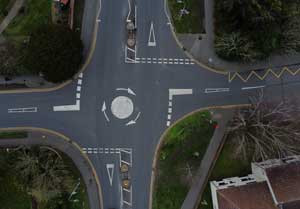
This month I would like to look at mini-roundabouts, which are covered under rule 188 of the current (2022) edition of the Highway Code.
Mini-roundabouts are small, usually painted on to the surface of the road and designed to manage traffic flow.
The Code advises drivers to 'approach these in the same way as normal roundabouts.' My own experience is that in principle drivers tend to know that they should do this, however three things seem prone to go awry when negotiating mini-roundabouts;
- The issue of who has precedence. Because the space is so tight, a point acknowledged in the Code itself, 'Remember, there is less space to manoeuvre and less time to signal' it can result in a stand-off between drivers entering the mini-roundabout from different directions.
- The tendency of drivers to pass over the painted mini-roundabout itself, or part of it.
- The danger posed by drivers making a U-turn on the mini-roundabout.
- If they are already crossing, you must stop.
- If you believe that they might cross (perhaps without looking), then as a safe driver obviously you should stop.
- If they are waiting to cross and have looked your way, then you have to decide whether or not to stop. You should do so, but only if it is safe to do so, because there is no vehicle likely to collide with you from the rear (who is probably not aware of the pedestrian). In this circumstance, do not beckon the pedestrian to cross; it is their choice.
I will try to tailor my driving tips to meet each of these separate challenges.
In relation to the first issue, namely that of precedence, it is always in my view a sound strategy to approach mini-roundabouts where it is not immediately obvious that the hazard is completely clear of traffic and will remain so, at slow speed and carefully apply the usual rule of giving way to the right.
If there is a stand-off and vehicles come to a halt and do not take their precedence, then as advanced drivers we have the skills to use our sense of timing and take the initiative and make use of the mini-roundabout to ensure that the traffic flow is maintained.
When doing this we are taking on the responsibility for the situation and need to be mindful of this.
On the second issue, that of driving over all or part of the mini-roundabout, the Code is very clear 'All vehicles MUST pass round the central markings except large vehicles which are physically incapable of doing so.' In other words you would be committing an offence if, whilst driving a car or small van sized vehicle, you do not use the wider path around the mini-roundabout. It is this 'cutting' of part or all of the hazard that can lead to accidents, as there is precious little space for error with compact mini-roundabouts, without drivers taking a path across them.
In practice some mini-roundabouts are so designed that to avoid running over part of them is difficult, even at a suitable low speed. As advanced drivers we need to be aware of this, particularly when we have local knowledge of the road in question and be extra cautious.
In relation to the final issue, that of U-turns, the Code advises 'Avoid making U-turns at mini-roundabouts. Beware of others doing this.' It is not an offence to do so, however if you were to carry out this manoeuvre and as a result an accident were to occur, then there might be a case of driving without due care and attention to answer.
The Code rightly cautions us to be aware that others might do this and thereby cause confusion or an accident.
Training Officer, Chelmsford & South Essex Advanced Motorists
See Highway Code Online: https://www.gov.uk/guidance/the-highway-code
April 2026 - Hierarchy of Road Users
The latest edition of the Highway Code was released by Driver Standards Agency in 2022 and included several changes that many drivers are not aware of. One of the most potentially controversial of which is the Hierarchy of Road Users. This section of the Code has three rules listed as H1 to H3.
I would like to focus on rule H2 which applies to all drivers, motorcyclists, horse riders, those operating horse-drawn vehicles and cyclists i.e. pretty much everyone.
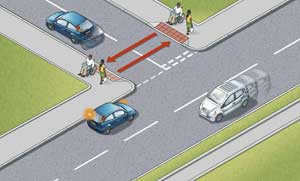
The new feature in 2022 was that the rule now opens with the sentence; 'At a junction, you should give way to pedestrians crossing or waiting to cross a road into which or from which you are turning.' During the consultation on the 2022 Code this caused some concerns based on the disruption to the flow of traffic, particularly in busy towns and cities, that they envisaged would be caused by cars stopping as they were making a left or right turn, to let pedestrians cross the road, especially as it refers to those 'waiting to cross' as well as those already in the road.
I imagine that the reason why this rule has not caused more difficulties than it seems to have is that most people either are not aware of the change to the Code, or do not apply it.
The rule is a 'should', rather than a 'must'. So there is no specific offence of not complying with this, although of course failing to accord the necessary priority to pedestrians could provide evidence in a case of driving without due care and attention, or indeed in any civil damages case.
My driving tips can be summarised as follows:
Remember this rule when turning left or right into a junction and there are pedestrians crossing or waiting to (or about to) cross.
The spirit of this rule is to allow pedestrians to be safe by giving them priority, it is not intended to cause collisions on the road and in my view should be interpreted in a sensible and pragmatic manner.
July 2026 - Gear Changes
This month I would like to discuss a topic relevant to those of you who have vehicles with manual gear boxes. I appreciate that these are becoming a rarity these days owing to the number of vehicles fitted with automatic gear boxes and increasingly of course those with electric drive trains. Despite this change in the types of gear box available to drivers, there are still manufacturers who build manual vehicles and many of us will have older cars fitted with a traditional manual box. The topic that I have in mind is making smooth gear changes.
The Highway Code makes next to no mention of gear changing, the only exceptions being in special circumstances, such as parking on a hill when you do not want to completely rely on the handbrake to hold the vehicle. 'The Advanced Driver Course Book' and its' parent publication 'Roadcraft' both emphasis the system of car control, namely IPSGA, with the 'G' for 'Gears'. The Course Logbook states that we should 'Conduct gear changes in a smooth steady manner' and further that 'When required they should match engine revolutions to road speed.'
Why might we be concerned to make our gear changes as 'smooth and steady' as possible? I think that there are several reasons for this, one being that we, as advanced motorists, want to drive in a smooth and unobtrusive manner, giving the impression of quiet competence. This is achieved in part by being silky smooth with the controls of the vehicle, including the gear changes. We should aim to give passengers the feeling that we are making steady and smooth progress without the journey being punctuated with unnecessary noise and vibration. We want them to feel that they are 'gliding' along the route. Secondly, we want to reduce the wear on our vehicles where possible by using the clutch and gear box efficiently and smoothly. Thirdly we want to reduce the unsettling inputs into the vehicle that might destabilise it either at speed, or in road conditions where the grip is limited.
So how do we achieve this desirable state of affairs and make our gear changes smooth and steady? The Course Logbook suggests that we might 'Employ a rev on the down change or sustained accelerator pressure to match engine revs to road speed.' But what does this actually mean? We can smooth out our gear changes in two different directions, changing up a gear and changing down a gear, but they require two different approaches. Let us start with changing up a gear, or in the case of advanced driving, changing to whichever gear is most appropriate, which of course may involve swopping from second to fourth, or any other appropriate configuration. When changing up the gear box, try to hold on to the higher revs for just a moment to allow the car to settle at that speed and then make the up change, perhaps momentarily putting the gear lever into a neutral position for just a second or two, what a colleague of mine described as 'acknowledging neutral'. You should find that it makes your gear changes less hurried and more deliberate and allows then revs to settle at the higher speed before moving into the higher gear.
The arguably more challenging situation is in changing down from a higher gear to a lower, perhaps from fourth to second, or any other such configuration. The road speed and the engine speed will be very different and this coming together of the clutch plates and the internal drive shafts can often be felt vehicle inside the vehicle. Some modern sports cars have a system called auto rev matching which eliminates this problem entirely. For those of us who do not have this system, we can adopt the advice from the Course book and essentially rev match ourselves, dipping the clutch, moving the gear stick into the gear we require e.g. second and then blipping the throttle and then bringing the clutch up smoothly and efficiently. With practice you should feel that your down changes feel silky smooth. Because the engine revs now match those required for the lower gear you should reduce the strain on the clutch plates.
Prior to this method of rev matching being adopted by many drivers, the preferred method was one of double de-clutching. This was taught by police driving schools up until the late 1990s and was essential for making down changes in cars which were manufactured prior to the introduction of synchromesh gear boxes. This method relies on dipping the clutch, moving the gear selector into neutral, raising the clutch and blipping the throttle, then dipping the clutch again and selecting the gear, then smoothly coming off the clutch. In other words, it introduced an additional stage to the process. The police stopped teaching this method due to its being made unnecessary by modern gear boxes, although those with classis and vintage vehicles still find it essential in both up and down changes, as it spins up the internal shafts and gears to match the speed of the output shaft.
For completeness I will mention a further technique for down changes employed by some road drivers, but more common amongst racing drivers, namely heel and toe changes. These provide a driver with the advantage of being on the brakes and losing speed and then dipping the clutch and selecting a lower gear, using the heel of the right foot to blip the throttle and keep the braking on at the same time. This is not for the faint hearted!
In summary, if you would like to make smoother gear changes for any or all of the reasons set out above, you might try holding on to the revs and the gear that you are in for a few seconds after accelerating, then taking your higher gear. On down changes you might try just blipping the throttle whilst the clutch is still down, having moved the selector to a lower gear, then bringing the clutch up smoothly. Try it out, but be patient if this is new to you.
See the Highway Code Look for Hierarchy of Road Users.
Training Officer, Chelmsford & South Essex Advanced Motorists